
He Found His Trade in Flip-Flops. Thirty Years Later, He Calls It a Brotherhood.
A Saturday helping a friend in a Montana crawl space introduced Eric to sheet-metal work. At 55, he is still building HVAC duct systems alongside tradespeople young enough to be his children—and wondering who will take their place when his generation retires.

JP Lespinasse
VP of Brand, Content and Comms, Lightcast

Eric describes sheet-metal workers as “the land of misfit toys.”
“We’re crude, we’re rude, and we’re not right in the head (laughter)” he said. “But when we start doing stuff, it’s awesome.”
The quirks are part of the bond. Eric has spent approximately 30 years working with people who build and install the ductwork that carries heated, cooled, fresh, and exhaust air through homes and commercial buildings. The work can mean long days in dark corners, cramped crawl spaces, and unfinished buildings.
Those conditions have a way of bringing people together.
“Ninety-nine percent of everybody I’ve ever worked with, we click in the weirdest way,” Eric said. “It’s like a brotherhood.”
Some of his closest friends in the trade are 30 years younger than he is. When they go out together, the age difference recedes. Eric becomes “Bulldog,” the veteran who keeps his younger coworkers guessing about what he will do next.
At 55, he could be their father. On the job, they are brothers.
The Saturday that changed his career
Eric grew up in California and began working at a meatpacking plant a few years after high school. He liked the physical demands of the job and described it as “getting paid to exercise.”
He later attended Universal Technical Institute in Phoenix, studying subjects that included air conditioning, refrigeration, electrical systems, and automotive repair. The program compressed large amounts of technical instruction into short phases.
The education came with a considerable bill for someone in his early 20s. When Eric moved to Montana, entry-level HVAC jobs paid around $5 an hour. He wanted to repay his education, have some spending money, and someday buy a ranch. The available wages did not seem likely to get him there.
He eventually accepted an HVAC maintenance job in Missoula and hated it. Then a friend called on a Saturday and asked whether Eric wanted to help run some ductwork. Eric had never done that kind of work. He showed up in shorts, a T-shirt, and flip-flops. The job was in a crawl space.
“I was like, ‘Man, you could have explained this a little bit more,’” Eric recalled.
The flip-flops quickly came off. Eric spent the day crawling over dirt and rocks on his bare knees. By the end, he was bruised and battered. He had also found his trade.
“I really liked it,” he said. “You’re building something, hanging something, making something happen.”
That Saturday was in 1995. Thirty years later, Eric is still doing the same fundamental work.
A blue-collar family tradition
The skilled trades ran through Eric’s family, although no one clearly explained the possibilities to him when he was young.
His grandfather, father, brother, brother-in-law, and one of his father’s cousins were all Millwrights. They erected steel and worked with large machinery, including water and air turbines in industrial plants. Eric grew up surrounded by people who made their living through skilled physical work. Still, he did not fully understand what a Millwright did until he asked his father.
The career was in the family, but the pathway was never explicitly offered to him.
Like everyone, Eric knew what air conditioners and heaters were. He understood that they made buildings comfortable. No one talked to him about the people who installed the systems or the ductwork carrying air throughout those buildings.
“You don’t think about the fact that someone has to install and maintain them,” he said. “They just exist in your home.”
Eric discovered the work almost by accident. Many people enter the trades through a similar mix of family, friendship, and proximity: a parent who knows an employer, a relative who needs help, or a friend who invites them to a jobsite. The knowledge often travels through relationships before it reaches a classroom or career counselor.
Building something that has to work
Sheet-metal work involves more than assembling pieces of metal.
Codes determine where ductwork can run, what it can hang from, and how thick the metal must be. Requirements change depending on whether a system carries fresh air, exhaust, heated air, or cooled air. Inspectors review the finished work.
The details may vary from one project to another. Eric might encounter an unfamiliar gasket, material, or installation method. Decades of experience give him a foundation for understanding what the system needs to accomplish and how the pieces fit together.
“The sky’s the limit, really,” he said of the skills available within the trade.
Eric can work across multiple areas of HVAC and refrigeration because of his technical education. He chose ductwork because he enjoyed creating something physical. The people who eventually occupy a building may never know who installed its ventilation. They notice only that the air conditioning turned on or that the room became comfortable.
“It is a little bit like magic,” Eric said. “Though they don’t say, ‘Oh, Eric did that.’ They’re like, ‘Oh, man, the AC kicked on.’”
The recognition comes from within the crew.
“Your satisfaction comes from you and your brothers doing this or doing that,” he said. “We don’t want medals (metals), but if there was a medal, I’d probably take one.”
And he noted it’d be fun it it were made of stainless steel, like the ducts he works on.
Thirty years between coworkers
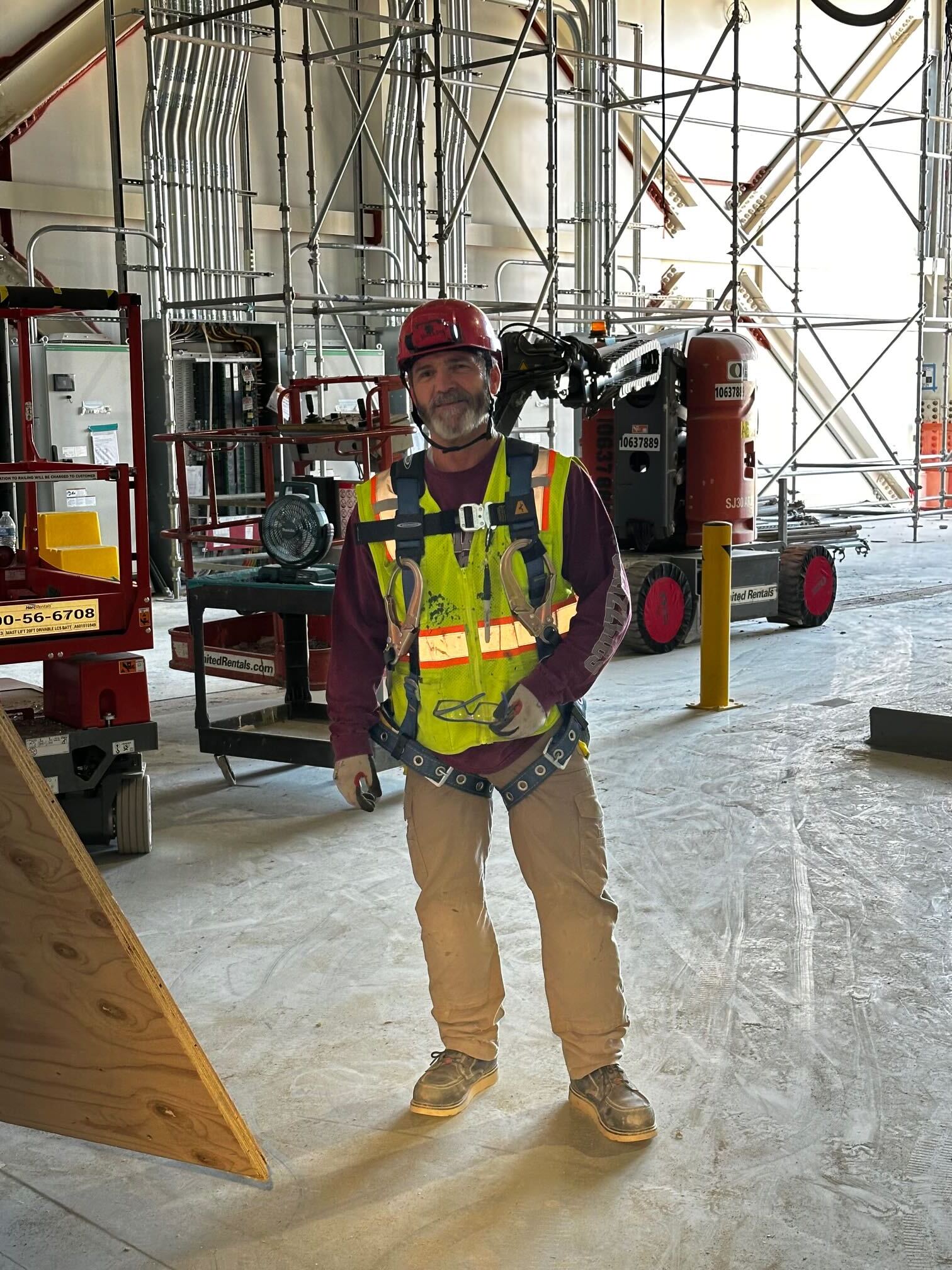
More than one-quarter of US skilled-trade workers are 55 or older. Eric is now part of that group, working alongside people who represent the next generation of his trade. Some of his closest coworkers are in their 20s. They exchange jokes, give one another nicknames, and tease the other trades on the jobsite. Electricians are a favorite target, although Eric readily admits that every trade has its own expertise.
“They can’t do our job, and we can’t do theirs,” he said.
Underneath the mockery is mutual respect. Each group understands the skill required to turn an unfinished structure into a functioning building. Eric’s friendship with younger workers also complicates the common story that young people do not want to work in the trades. He sees talented younger people doing the work beside him. His concern is whether enough people know that these careers exist.
“I don’t know who’s going to do this when I retire,” he said.
Eric believes high schools and career counselors should introduce students to multiple trades and give them opportunities to try the work. A teenager may have little reason to understand the difference between a Sheet Metal Worker, Millwright, Electrician, Plumber, or HVAC Technician until someone puts the tools and the career options in front of them.
For Eric, that moment arrived in a crawl space, wearing the worst possible shoes.
An honest living and a good life
Eric recently left a company where he had worked for nearly 15 years. The departure was emotional because of the relationship he had built with the owner and his coworkers.
He is now in Boise, working six 10-hour shifts each week on swing shift. The schedule is demanding, but he has a clear goal: pay everything off, put money in the bank, and retire early enough to spend more time fishing and visiting his daughter.
After three decades, Eric is honest about the physical cost of the work.
“My body’s like, ‘Dude, retire in two years. Let’s go fishing,’” he said.
He is equally clear about what the trade has given him. Sheet-metal work allowed him to raise his children and provide them with a good life. It offered steady demand, strong earnings, lasting friendships, and the satisfaction of making something useful.
“It’s not the worst thing. It’s not the best thing,” Eric said. “But it’s an honest living.”
He wishes he had learned about the opportunity earlier.
Thirty years after that Saturday in flip-flops, Eric can look around a jobsite and see both ends of the skilled-trades story. He sees the family tradition that preceded him, the younger workers carrying it forward, and the friendships that make difficult work sustainable.
He also sees a trade that will remain necessary long after he finally leaves for the fishing boat.
“HVAC will always be around and needed,” he said. “No matter what they come up with—AI robots or whatever.”


