
How Many Jobs Does a Data Center Create? Construction vs. Permanent Jobs

Data center announcements often celebrate the thousands of new jobs that will be created. But what does that number actually mean?
Construction employment can deliver a significant short-term economic boost, while permanent employment determines the project’s ongoing workforce and local economic footprint. Communities need to understand the difference when evaluating data center development:
A major data center project can require between 1,000 and 10,000 construction workers during development. Once the facility is operational, however, the long-term workforce may be closer to 50 to 400 permanent employees.
Data Center Construction Jobs vs. Permanent Jobs
The construction phase requires a large workforce with varying levels of seniority and experience. Data center projects need construction managers, electricians, HVAC technicians, inspectors, equipment operators, carpenters, steel workers, estimators, foremen and mechanical, electrical and plumbing specialists. (Complicating matters further, the United States’ shortage of workers in the skilled trades means these workers are already in high demand.)
The operational workforce is smaller but often requires more specialized experience. Permanent roles may include data center technicians, engineers, network specialists, facilities professionals and operations managers.
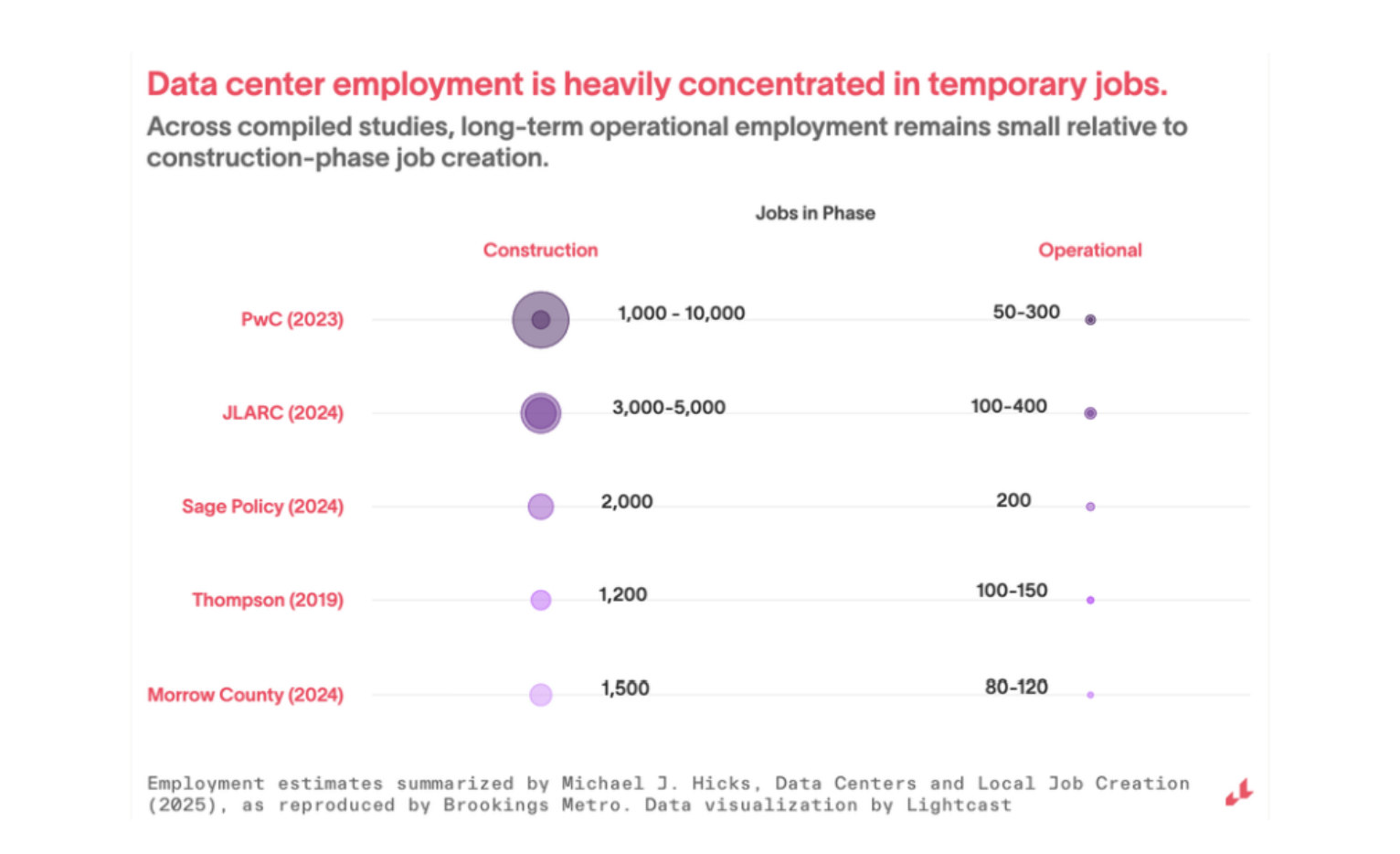
Source: Lightcast, “Data Centers and the Local Workforce,” pp. 4–5.
This construction-to-permanent employment gap creates a potential measurement problem. A project may generate thousands of jobs while it is being built, but only a few hundred long-term positions once construction ends.
Communities and their leaders will need to judge for themselves whether that tradeoff is a good deal, but they should not make that decision without knowing the facts. When evaluating the project’s long-term benefits, temporary employment should be distinguished from permanent employment.
The Practical Impact of 1,000 Construction Jobs
To illustrate the difference, Lightcast modeled the potential economic impact of a data center in the Laredo, Texas metropolitan area. (Existing projects in the region provide a baseline that allows for a more accurate analysis.)
The construction scenario assumes 1,000 jobs in commercial and institutional building construction. The Lightcast Input-Output Model estimates that this activity could generate:

Source: Lightcast, “Data Centers and the Local Workforce,” pp. 5.
The difference between 1,000 direct jobs and 1,443 total jobs reflects the broader economic activity associated with the project. Construction companies purchase goods and services from local suppliers. Workers spend their earnings in the regional economy. Those supply-chain and household-spending effects create additional employment beyond the initial construction workforce.
The model focuses on commercial and institutional building construction while incorporating related activity—such as electrical, plumbing, HVAC, engineering and architectural services—through indirect and induced spending. This approach helps avoid double-counting jobs across closely related industries.
What Happens After Construction Ends?
The permanent operating phase produces a smaller direct workforce, but those jobs may continue for many years.
Lightcast modeled a scenario involving 100 long-term data center jobs in Laredo. The results were:

Source: Lightcast, “Data Centers and the Local Workforce,” pp. 6.
In other words, every 100 direct operating jobs are associated with 74 additional jobs through direct, indirect and induced economic effects.
The operational scenario includes computing infrastructure providers, data processing, web hosting and related services. Although the direct workforce is much smaller than the construction workforce, the ongoing activity can support local suppliers, services and household spending over time.
Data Centers vs. Realistic Alternatives
A data center should not be evaluated against “no investment.” Communities should compare it with other plausible uses of the same land, infrastructure, workforce and incentives.
Lightcast modeled several alternative 100-job expansions in Laredo:
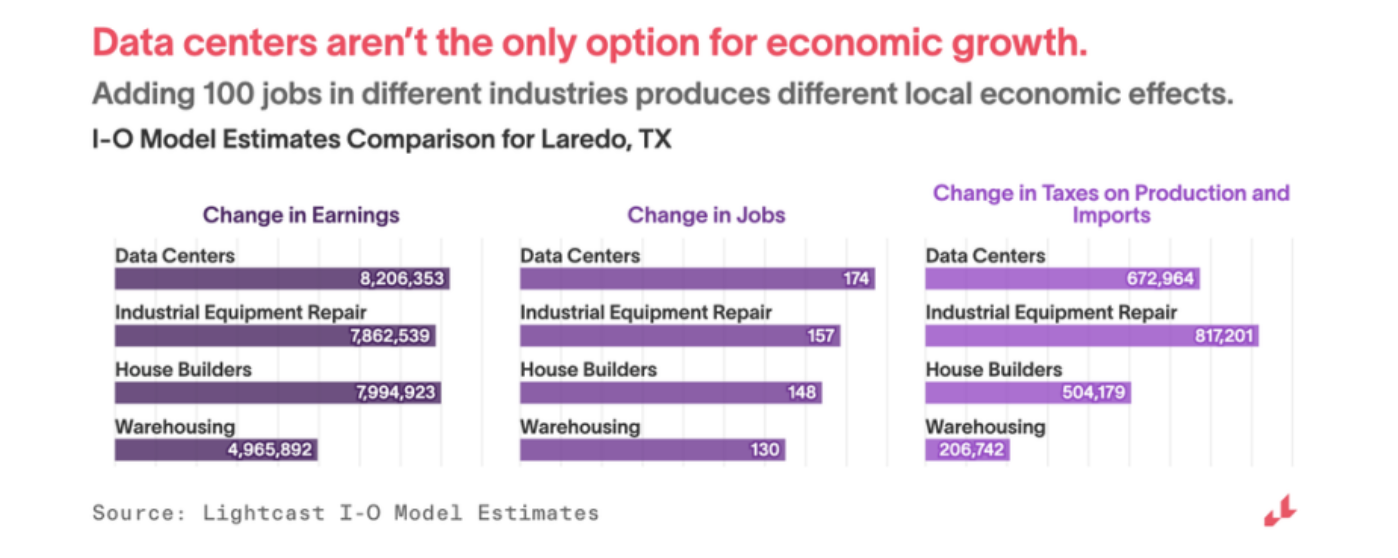
Source: Lightcast, “Data Centers and the Local Workforce,” pp. 7.
The comparison does not mean that one industry is universally better than another. Each option has different infrastructure requirements, wage profiles, tax implications, land needs and strategic value.
Economic impact depends on the alternatives available to a community. A data center may produce substantial jobs, earnings and tax revenue, but its return should be evaluated alongside other investments that could compete for the same workers and resources.
Workforce Limitations Can Constrain Economic Benefits
The headline job count is only useful if the region can supply the required talent.
Lightcast identified 24,721 unique construction job postings that referenced “data center” globally between September 2025 and February 2026. That was a 23% increase over the previous six-month period, when there were 19,372 postings.
This is a conservative estimate because many contractors do not mention the end project in their job postings. Even so, the trend shows that demand for data center construction talent is rising.
The same electricians, HVAC workers, project managers, inspectors and equipment operators needed for data centers are also needed for housing, utilities, manufacturing, roads, schools, hospitals and energy projects. A region may have the land and investment interest to attract a data center but still face a labor shortage that limits the project’s local impact.
What Communities Should Measure
When evaluating the potential of a data center project, regional leaders should ask:
How many jobs will exist during construction?
How many permanent jobs will remain after completion?
How many workers and skills are available locally?
Which industries will compete for the same talent?
How does the project compare with realistic alternatives?
What portion of the projected economic impact will stay in the region?
The most credible data center economic-impact analysis separates temporary construction employment from permanent operating employment, then measures the wider effects on earnings, suppliers, households and tax revenue.
Model Economic Impact with Lightcast
Turn complex scenarios into clear, defensible impact stories. Backed by two decades of labor market intelligence, the Lightcast Input-Output Model helps organizations estimate how jobs, earnings, and industry output ripple through regional economies.
By modeling direct, indirect and induced effects, the model can estimate changes in:
Employment
Earnings
Industry output
Supply-chain activity
Household spending
Tax revenue
Having that data makes it possible to compare construction and operational scenarios—and evaluate a proposed data center alongside alternative investments.
Economic-impact modeling estimates the potential return; workforce analysis tests whether the region has the capacity to realize it. Used together, they let communities compare data center proposals with realistic alternatives on the same terms.


