
The Rise of Fractional Leadership
How Companies Are Rethinking the Executive Team.

Elena Magrini
Head of Global Research, Lightcast

Alongside AI-driven transformations in daily work, a significant new trend is emerging in the labour market: fractional leadership.
Fractional leadership is a flexible and cost-effective way to manage a business, whereby senior executives such as CFO, CMO, and business managers work for a specific company on a part-time basis.
But how pervasive is this shift, where is it most prevalent, and how has this changed over time? I'll answer these questions, drawing from Lightcast job postings and professional worker data to map the rise of the fractional executive.
How big is fractional leadership?
As of 2025, there were at least 34,000 workers in the US whose current job title mentioned “fractional”. This number is up by 265% compared to 2019. The rise is even bigger on a global scale, with the number of fractional profiles up by 313% since 2019.
Demand is also growing fast in job postings. The chart below shows the number of job postings recruiting for fractional roles in the US. In 2025, there were 677 job postings for fractional roles. This is more than double the year prior, and the trend is growing fast: in the first seven months of 2026, there have been nearly a 1,000 postings for fractional roles - more than in the whole 12 months combined for 2025.
Both data sources - job postings and profiles - point in the same direction: fractional leadership as a new emerging field, rising rapidly from a small basis.
Which organizations are adopting fractional leadership?
Most fractional leadership workers work for medium to small size companies. Only 0.3% list they are currently working for a Fortune 1000 company.
Job postings tell a similar story: in 2026, 97% of all fractional job postings were posted by medium and small size companies, and only 3% by Fortune 1000 companies. This is consistent with 2024, while the share of Fortune 1000 fractional job postings in 2025 was higher - at 5%.
These findings align with the business model behind fractional leadership. These roles are often brought in to manage costs effectively, and this is disproportionately more important for small and medium sized companies.
Where is fractional leadership most prevalent?
Finance accounts for nearly half of all fractional job postings in the US (46%), with Chief Financial Officers by far the specific occupations accounting for the largest number of fractional leadership postings.
While finance still dominates demand for fractional roles, the most noticeable change over time is the expansion of demand for fractional roles way beyond finance. Back in 2019 and 2020, fractional demand was barely demanded outside of Finance and Sales, while increasingly a broader number of career areas mention it. For example, beyond finance, business management now accounts for 12% of all fractional leadership postings, followed by marketing and PR (10%).
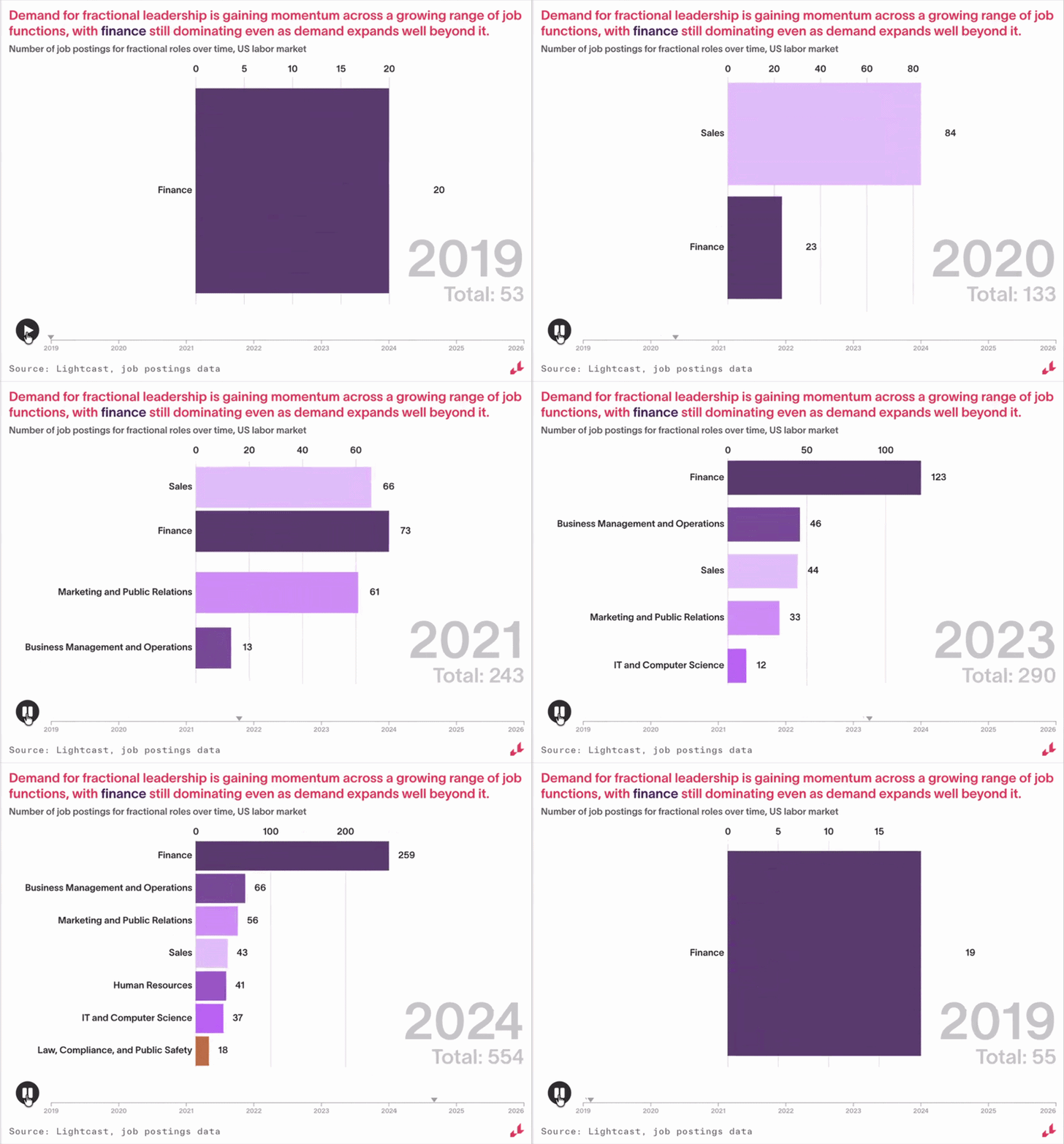
The numbers are still relatively small, but the direction of travel is clear. Fractional leadership is growing rapidly, spreading beyond its roots in finance, and giving smaller organisations new ways to access senior expertise. As companies rethink what their leadership teams need to look like, fractional executives could become an increasingly established part of the talent landscape.


