
Healthcare Is Not Immune to AI Disruptions

Hannah Grieser
Researcher & Designer, Lightcast

FAULT LINES | HEALTHCARE, Part 3: Artificial Intelligence
Introduction: Three major Fault Lines are rattling the global labor market: labor shortages, geopolitics, and artificial intelligence. Healthcare sits squarely within the fault zone of all three.
This third installment of our three-part series covers the disruptive pressures that artificial intelligence is starting to have on the Healthcare labor force in the US.
So far, AI adoption has been slowest in sectors where workers are needed most, including Healthcare.
The Healthcare roles seeing the greatest AI-driven change are office and administrative occupations.
Medical manufacturing is a Healthcare-adjacent industry where AI demand is rising and bringing a salary premium.
Opinions on AI are widely divided, especially when it comes to how AI will—or should—impact Healthcare.
Potential risks and low public trust in AI’s ability to bring positive change may restrict future AI adoption in the Healthcare industry.
As addressed in parts one and two of this series, Healthcare’s demand for workers is intensifying, but pressures from demographic shifts, education shortfalls, and geopolitical disruptions are squeezing the Healthcare labor supply. To fill the Healthcare talent gaps, many are looking to artificial intelligence as a possible solution. The hope is that this emerging technology could make Healthcare work more efficiently or even eliminate the need for some roles altogether. But despite the potential AI applications, the question remains: is an AI revolution really transforming the Healthcare workforce?
The AI Adoption Gap
It’s no surprise that tech jobs were the earliest to adopt artificial intelligence into their workflows, but over time, adoption has spread beyond the tech sector and into the broader market. Today, a majority of demand for AI skills comes from outside of tech-specific occupations.
As we reported in our Lightcast research report Beyond the Buzz, AI skills also come with a salary premium, regardless of the career area. In Healthcare, postings asking for two or more AI skills offer an annual salary boost of nearly $30,000.
Despite the steady rise in AI skill demand across occupations, Healthcare’s adoption of artificial intelligence in the workplace has been relatively slow—even lagging behind other non-tech, highly physical industries like Construction.
This AI adoption gap may help provide job security for the existing Healthcare workforce, but in order to meet the growing Healthcare needs of the US population, this gap may also be reason for concern since AI adoption is lowest where workers are needed most. Whether Healthcare’s looming labor shortages can be addressed by this new technology, as some AI enthusiasts expect, remains to be seen. So far, the reality is far less dramatic than many of the headlines.
This isn’t to say that AI adoption is absent from the Healthcare industry. While none of the Healthcare occupations we analyzed show both high exposure to AI augmentation or high demand for AI skills, the impact of AI varies widely by occupation.
The greatest AI inroads in Healthcare can be seen in jobs involving more record-keeping and administrative tasks than in-person work with patients. And just because a job’s skills can be augmented by AI does not mean they are. The job of a Medical Secretary, for example, involves skills that are highly exposed to AI, but the job itself has yet to incorporate high AI adoption.
AI-Powered Growth in Medical Manufacturing
Manufacturing may not officially belong to the Healthcare industry, but the subsets of Manufacturing that produce pharmaceuticals, electromedical devices, and medical equipment have a direct role to play in Healthcare work. Medical manufacturing is also an area where AI demand is rapidly growing.
US postings for medical manufacturing jobs with AI skills have more than doubled in the past two years, and advertised salaries have risen 21%, bringing a $42,000 premium compared to industry jobs without AI skills.
But as AI-powered medical manufacturing brings groundbreaking innovations to the Healthcare workplace, it also requires practical and regulatory changes to help ensure that patient wellbeing is still protected and legal standards are met.
The AI Trust Gap
In spite of the rising demand for AI-savvy workers in select Healthcare occupations, public enthusiasm stands on shakier ground. As reported in the Stanford AI Index Report, opinions about the future impact of AI is highly divided between AI experts and the general public. The gap is especially wide when it comes to what AI will do for medical care. This 40-point difference of opinion is substantial, but understandable when we consider what’s at stake: the lives and wellbeing of an entire population.
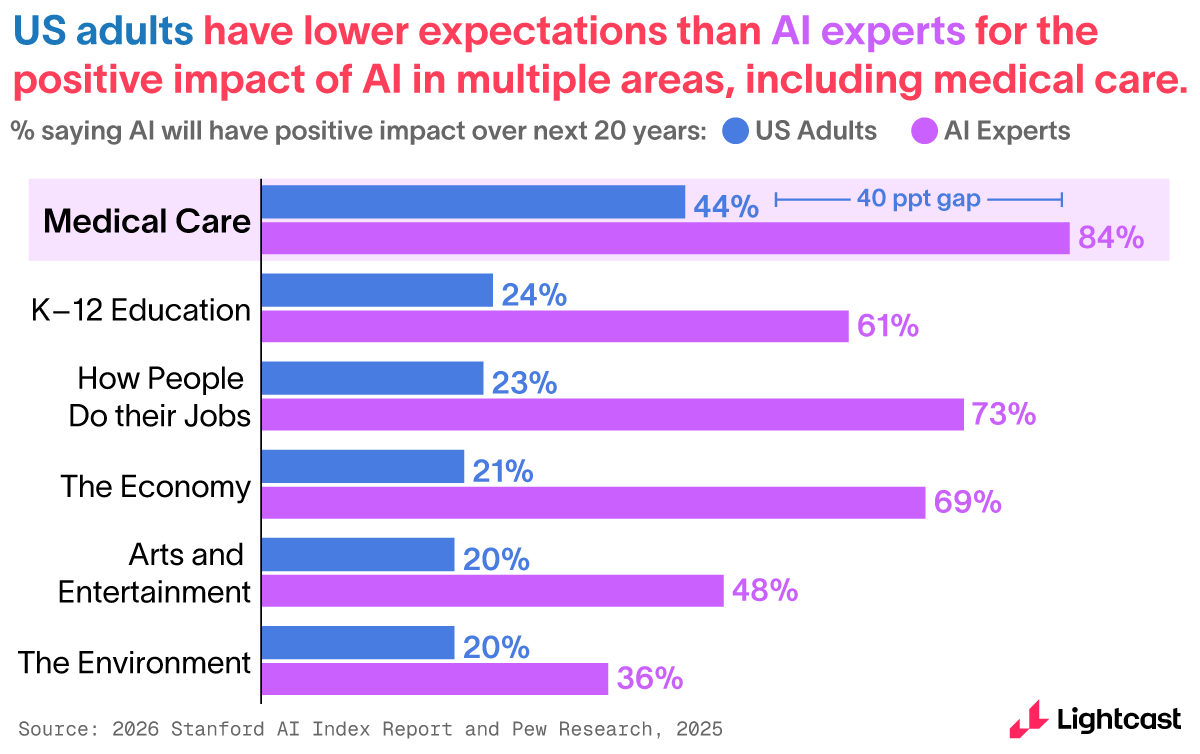
AI optimists can point to recent innovations that could transform Healthcare through improving diagnostics, discovering new cures, or even taking the place of skilled surgeons. Skeptics, on the other hand, worry that AI lacks adequate regulation to protect patient safety and privacy and that AI-generated output can lead to medical malpractice or even wrongful death. A recent Gallup poll also found that even among people who use AI to find health information, only 4% strongly trust the accuracy of the information that AI provides.
To gain the support of the public, the trust gap is a serious hurdle for wider AI adoption, especially within Healthcare. This message seems to be getting through to employers; across the labor market, we’re already seeing more attention given to building trust. As we reported in our recent blog, the market value of trustworthiness has been on the rise in job postings for AI workers:
Conclusion
So what does the future hold for AI’s role in Healthcare? The answers seem to shift by the hour. As with any rapidly developing technology, competing interests and unforeseen events can change the trajectory overnight, and both the cheerleaders and the naysayers have their data-backed talking points.
New AI-powered medical devices show promise for improving the quality of Healthcare, and various AI-augmented tools can bring greater efficiency and ease worker demand. But so far, industry-wide AI adoption remains low. The speed of skill change is rapid in tech-heavy Healthcare occupations with high AI exposure, making future skill demands and training needs tough to anticipate.
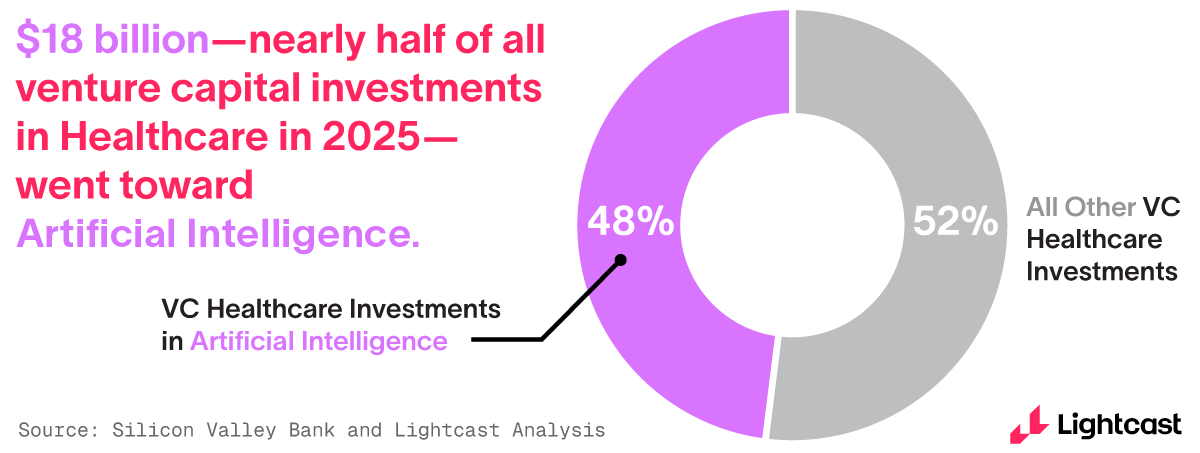
For many Healthcare investors, AI expectations remain high in spite of the uncertainties. Healthtech companies are on the rise, and heavy AI investments in Healthcare, totalling $18B between the US and Europe, reflect optimism about AI advancements in the industry.
However, it takes time to develop these AI applications—and even more time to find acceptance in the workplace. And as we’ve seen, this acceptance is by no means guaranteed.
To live up to the hype and to investor expectations, AI will have to push through a number of headwinds, from both inside and outside the Healthcare industry. These include talent gaps for AI infrastructure and development, increased scrutiny of data center projects, shortages of workers with AI skills, legal challenges, recent investment declines, academic and ethical worries, uncertain profitability, environmental concerns, patient privacy and security demands, job creation and destruction, and much more.
All of this makes the future of this emerging technology highly unpredictable for any industry. But the data we see in the present is clear: we haven’t entered a Healthcare AI job apocalypse now, but neither have we arrived at an AI-powered Healthcare utopia. The current reality falls somewhere in between—a kind of technological purgatory where labor market fault lines shake the Healthcare sector and shift how technology will shape it in the years to come.
As Lightcast’s Fault Lines report demonstrates, labor shortages, geopolitics, and artificial intelligence are the three major forces rattling the global labor market and putting new pressure on the Healthcare industry in unique ways.
To understand why the world of work seems to be shaking under our feet—and what strategies can help leaders prepare for the future—you can read the full Fault Lines report, listen to the audiobook, or explore the interactive experience on our website.



