
Labor Shortages Threaten to Shake up the Healthcare Industry

Hannah Grieser
Researcher & Designer, Lightcast

FAULT LINES | HEALTHCARE, Part 1: Labor Shortages
Introduction: Three major Fault Lines are rattling the global labor market: labor shortages, geopolitics, and artificial intelligence. Healthcare sits squarely within the fault zone of all three.
This first of our three-part series covers the labor shortages that threaten to shake the foundations of the US Healthcare system.
A convergence of several factors make Healthcare uniquely vulnerable to talent shortages:
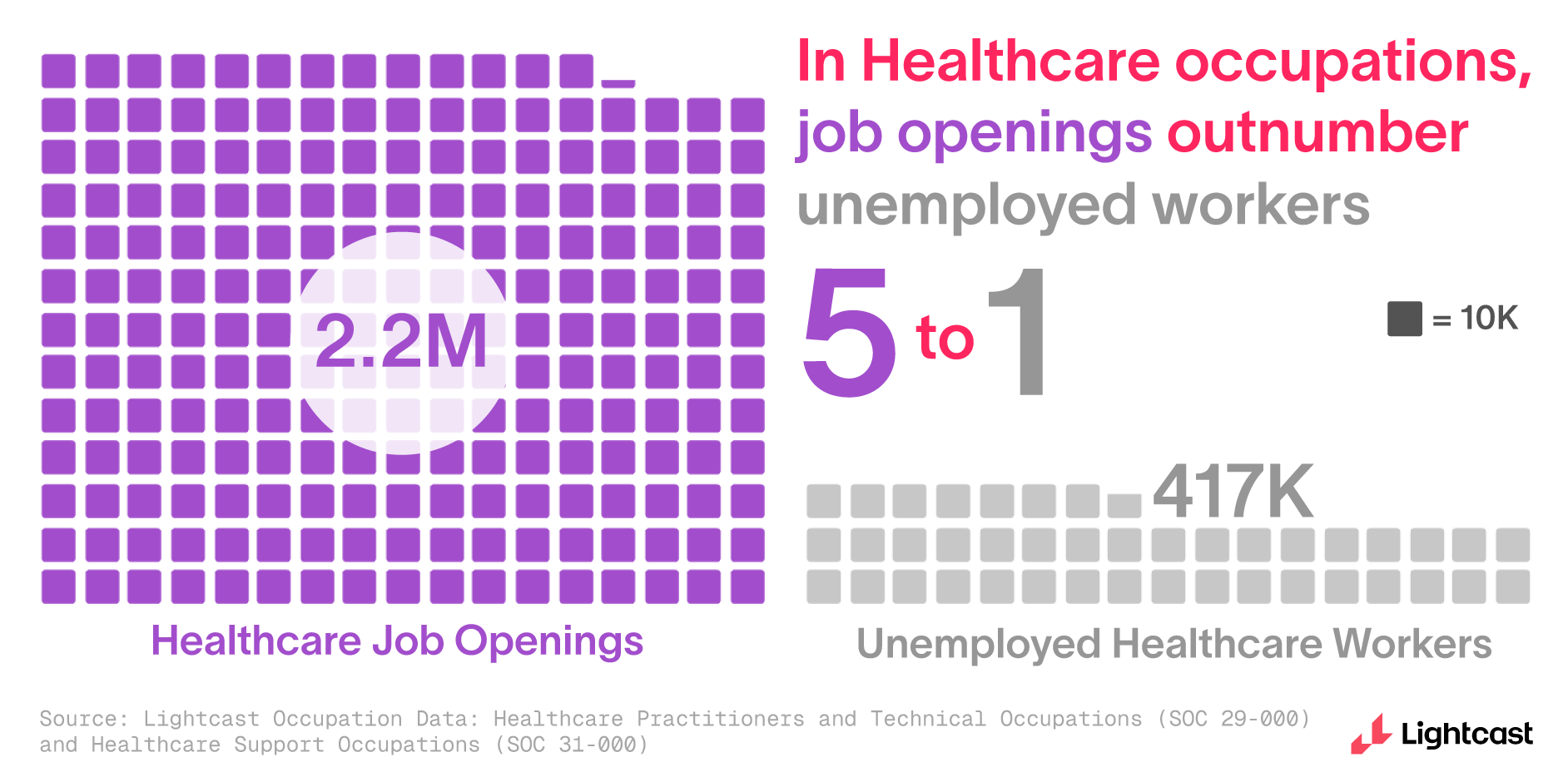
1. Across all Healthcare occupations, there are now more than 5 job openings for every 1 unemployed worker.
2. The aging US population means more Healthcare workers are retiring, just as Healthcare spending and demands skyrocket.
3. Fewer young workers are available to replace the surge in retirees, as a result of decades of falling birth rates.
4. Immigration decline (which we’ll discuss in part 2 on geopolitics) spells trouble since foreign-born labor supplies an outsized share of workers in Healthcare.
5. Hiring and retention difficulties, especially in lower-paid roles, stem from inflexible, in-person job requirements and difficult working conditions.
6. Instructor shortages for Healthcare education mean turning away qualified applicants and multiplying labor shortages in the Healthcare sector.
Why We Should All Care about Healthcare
2.2 million job openings for Healthcare and Healthcare support occupations are currently waiting to be filled in the US, but fewer than 420K unemployed people are actively looking for work in these jobs. That’s a ratio of five to one. This severe mismatch between available labor supply and high demand is putting tremendous pressure on anyone looking to hire new talent for the Healthcare industry. It also puts the wellbeing of the US population at risk—which is why a labor shortage in Healthcare should matter to all of us.
A 2026 survey found that “73% of Healthcare executives say staffing shortages negatively affect their ability to provide high-quality care.” And they point to several specific roles as acutely difficult to fill. Among clinical roles, 98% of Healthcare executives pointed to physician specialists, and 86% to primary care physicians, as difficult jobs to fill. And among allied health roles, a majority of execs said that radiology techs and ultrasound techs are tough to find. But across the Healthcare workforce, labor shortages are an ongoing challenge that’s expected to intensify.
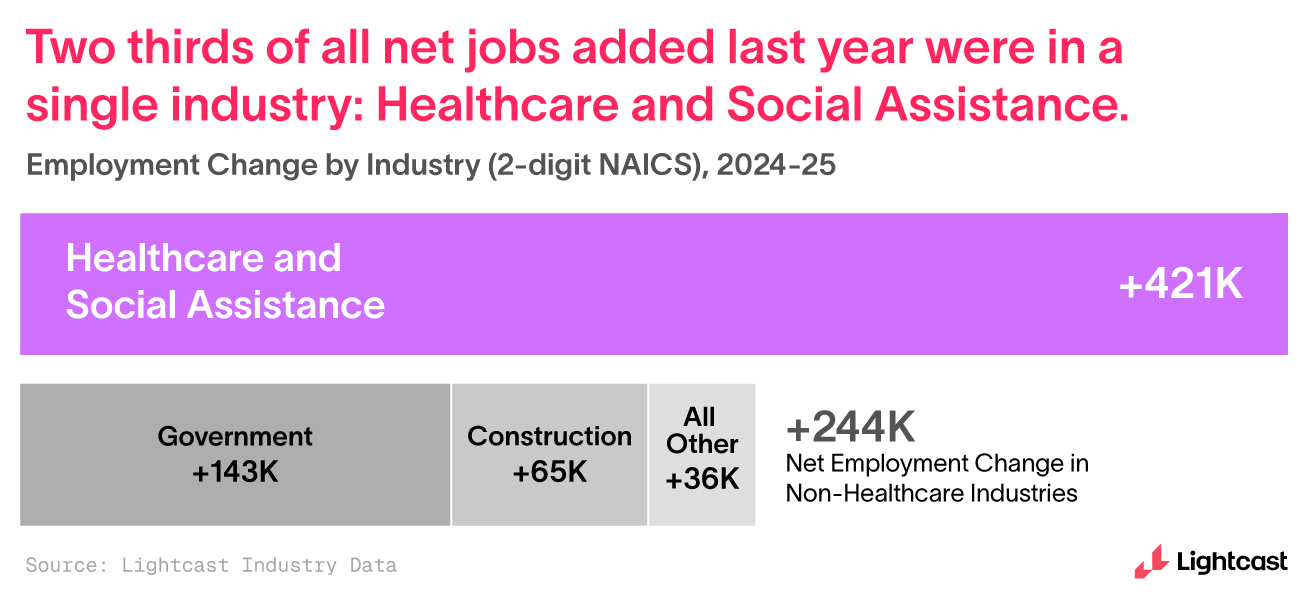
On the surface, however, talent shortages may not seem like a near-term issue. That’s because Healthcare employment has looked like a labor-market bright spot in the midst of a lot of otherwise tepid growth. Healthcare accounted for roughly two thirds of all employment growth from 2024-2025, and through mid-2026, industry employment has risen by over 1 million—three times that of any other industry. Without Healthcare, the US economy would now be losing jobs.
So why would health execs, of all people, cite labor shortages as a major issue? And why should the rest of us worry about it when Healthcare has essentially been carrying the labor market on its scrubs-wearing shoulders?
Well, for all six reasons listed above. Healthcare has been adding a lot of jobs, but it’s still not keeping pace with the demand for new workers. And that demand is only going to grow as the nation ages, as the supply of talent contracts, and as innovation struggles to keep pace with the need for greater efficiency.
Filling Healthcare roles is a problem that will require industry leaders, learning providers, and policymakers to work in concert toward a shared goal. The wellbeing of the entire population depends on getting this right.
Both Patients and Workers are Getting Older
When it comes to health-related goods and services, demographics are driving demand—and limiting supply. The population of Americans over the age 65 is expected to grow by roughly 1 million per year through 2034. This is creating a surge in new retirements across all industries. But no industry is poised to lose more workers to retirement than Healthcare. 2 million of the industry’s current workers are now 65 or older, and replacing that many retirees will be no small task.
If just replacing that existing workforce sounds daunting, remember that the current numbers may not be sufficient to meet future needs. An aging population also means that demand for age-related products and services will continue to grow.
The older the population, the more acute the need for a strong Healthcare workforce—from CNAs to surgeons. This growing demand is already showing up clearly in both job posting and employment trends, as we’ve seen.
In the US, Registered Nurse is now the top-posted occupation in all but one of the 50 states (where it ranks as number 2). But nursing is just one of several roles with high and rising demand.
Home Health and Personal Care Aides are also a fast-growing, high-demand occupation, as they play a critical role in elder care and nursing facilities. From 2023-2025, Home Health and Personal Care Aides was the #1 occupation (5-digit SOC) for employment growth in the US—adding more than 500K net new jobs. RNs came in second, increasing by 116K in the same time period.
The good news is that these health aide jobs have low barriers to entry and require no degrees. But low wages and high turnover also make attracting new workers a challenge. These are also jobs that have been disproportionately filled by foreign-born workers—a growing obstacle as immigration slows down.
The Retention Tension
Despite Healthcare’s massive job growth, the turnover problem is very real, especially in those lower-wage occupations.
Labor shortages are projected across a range of Healthcare jobs—from doctors to nurses to health aides. But in jobs with lower pay, health workers frequently start looking for better opportunities elsewhere.
As we reported in Lightcast’s Workforce Risk Outlook 35% of nurses said they were extremely likely to change jobs in the next year due to stress. And health aide roles are in even bigger trouble due to turnover. Even after a 36% increase in median salary over the last 5 years, home health aides still earn just one third the pay of registered nurses and have a nearly 70% turnover rate. With over 750K home health aide jobs openings to fill each year, these are workers we can’t afford to lose.
As new labor shortages come for the Healthcare industry more broadly, retention must become a higher priority. But you can’t retain workers you can’t find in the first place.
The Healthcare Education Gap
Entry-level, non-degreed Healthcare occupations remain in high demand, but the majority of roles in this sector require some kind of degree—including many requiring advanced degrees as well as post-degree training. This presents two known obstacles:
A degree in Healthcare can require a great deal of time and money, delaying the entrance of new workers and pushing completion rates down. Around 1 in 4 enrolled nursing students may not graduate.
The education system is also lagging behind the market’s demand for Healthcare graduates. Encouraging more students to pursue programs aimed at high-demand Healthcare jobs is critical, but recruitment is just one part of that equation. Due to education staffing shortages, institutions themselves are struggling to accommodate the number of applicants. Roughly 2,000 full-time nursing faculty positions remain unfilled, according to the American Association of Colleges of Nursing. One result of this instructor shortage is that over 65K qualified nursing applicants were turned away from programs in the US in 2022 alone, leaving a crucial stream of talent unable to take the next step toward a Healthcare career.
In the past, Healthcare programs saw steady growth. But recently, the Healthcare talent pipeline coming through the US education system saw a concerning dip. Growth in new graduates has slowed, and for the first time since the Great Recession, the overall number of college graduates in Healthcare-related fields actually fell from the prior year.
The drop in graduates was minor, but since it comes on the heels of 2 years of flattening growth, it may signal the start of a new trend. Over the next five years (2026-2031), the number of US high school graduates is projected to fall 5%. This looming “demographic drought” points toward shrinking enrollment, both in college more broadly and in Healthcare programs specifically. With fewer students, we need to improve outcomes for the students we expect to have. High-impact solutions include building learn-and-earn partnerships, employer-led apprenticeship opportunities, and a shift toward skills-based, rather than strictly degree-based, hiring. Regardless of where we live, creative strategies will be required to fill critical talent gaps in the Healthcare workforce.
Conclusion
The Healthcare labor market is multifaceted and complex, but its greatest problem can be summarized simply: demand for workers is greater than the supply. An aging workforce means fewer workers—while an aging population means we need more of them. Young people and new foreign-born workers are declining as sources of new talent. And even among those who choose to pursue a Healthcare career, inadequate training opportunities keep new workers out, while low pay and burnout keep existing workers from staying.
None of these pressures on the Healthcare labor force show signs of relenting, so the task for workforce leaders is to make the most of a diminishing talent pipeline.
As Lightcast’s Fault Lines report demonstrates, labor shortages are one of the three major forces rattling the global labor market. In the next two installments, we’ll also cover how artificial intelligence and geopolitics are putting additional pressure on the Healthcare labor force.
To understand why the world of work seems to be shaking under our feet—and what strategies can help leaders prepare for the future—you can read the full report, listen to the audiobook, or explore the interactive experience on our website:



