
Talent Attraction Success Stories in Surprising Places

Hannah Grieser
Researcher & Designer, Lightcast

The northeastern US has generally struggled to reach the top of our talent attraction rankings, but these MSAs are breaking that trend in important ways.
Lightcast’s 2025 Talent Attraction Scorecard, like the previous editions, emphasizes one ongoing trend: that the Sunbelt and Mountain West regions are dominating the talent attraction landscape. But while states like Florida and Texas are home to many top-ranked MSAs, other states contain notable success stories, despite challenges in the broader region. These high-ranking outliers may help provide strategic insights for MSAs located outside the usual talent-magnets.
In this article, we’ll focus on a handful of unique bright spots in the Northeastern and Rust Belt states, where overall rankings have typically been lower. The MSAs below are defying the odds by adding jobs and attracting new talent right where they are.
Location, Location, Location
Some regional advantages can’t be strategized away. Just as the sunny beaches of Florida draw both tourists and talent from around the country, attractive natural features can pull workers to other locations as well. Such is the case with two tiny island communities off the coast of Massachusetts: Nantucket (#35 overall) and Vineyard Haven (#79 overall).

Although both of these spots feature an above-average share of jobs supported by tourism, their talent attraction rankings differ by metric. When it comes to college-educated population growth, Nantucket breaks into the top 10, at #6 of all 924 MSAs nationwide. It also scores in the top 50 for high-earning job growth, making this island community an enviable spot offering high-paying work for college grads.
Vineyard Haven, on the famously swanky Martha’s Vineyard, is home to a greater share of retirement-aged residents. As a result, healthcare- and leisure-related jobs abound.This small metro ranks highest in its overall attraction of earners (#26). And its robust prime-age population grown (#41) is helping maintain the workforce needed to serve tourists and local retirees alike.
Competing for Competitive Effect
The lowest-ranked metric for MSAs in the northeastern states overall was Competitive Effect, which assesses regional job growth relative to national expectations and industry trends. But that didn’t stop three MSAs in the region from breaking into the Competitive Effect Top 50:
• Indianapolis-Carmel-Greenwood, IN (#24) is the MSA that keeps on truckin’. Literally. Its central location and ideal highway access to the rest of the country has helped make it into a major Transportation and Warehousing hub for the US.
• Bridgeport-Stamford-Danbury, CT (#42), known for its affluent “Gold Coast,” a popular spot for wealthy investors to call home, also boasts several Fortune 500 companies and provides above-average job concentration in management roles.
• Seaford, DE (#49)—which also comes in at #21 for High-Earning Job Growth and #29 for Overall Job Growth—offers a variety of waterfront advantages, a strong manufacturing sector, and proximity to Dover Air Force Base, all of which help propel outsized job growth. Seaford is one of the reasons Delware rose to #8 in our state rankings—the only state in the region to break into the Top 10.

Blue-Collar Boom Town?
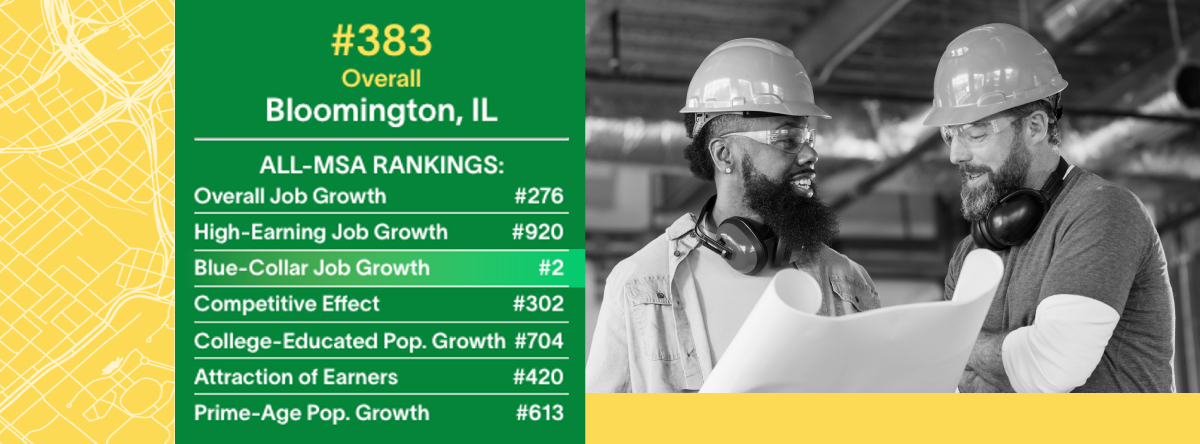
Bloomington, IL, lands squarely in the middle of the overall rankings, at #383 for all MSAs. But underneath the hood of that so-so rank is Bloomington’s top-notch score for Blue Collar Job Growth, which comes in at #2 in the nation. While Bloomington’s other metrics don’t fair so well, a strong blue-collar workforce—which is the envy of enterprises and economic developers around the nation—could prove to be a strategic advantage when it comes to drawing new business investments and stronger earnings in the region.
Learners and Earners
College-Educated Population Growth is a higher-ranking metric for the northeast as a whole, with its ivy-league institutions and respected universities. But what may come as a surprise is that the only three northeastern MSAs that land in the top #50 for this metric are found not in the New England states but in the Rust Belt:
• Coschocton, OH: #41
• Bellefontaine, OH: #28
• Marinette, WI-MI: #48
(• Plus Du Bois, PA, with an honorable mention at #51)
Attraction of Earners—which ranks the recent arrival of workers making $25,000 or more per year—indicates strong growth not just of total population but of people who are active in the workforce.
For this metric, Ann Arbor, home to the University of Michigan, ranks highest at #9 and boasts a younger-than-average, highly educated population, plus above-average concentration of jobs in Government and Education. But as with all MSAs with a major anchor institution driving talent growth, economic risks can come with the rewards. As higher education faces headwinds, a more diverse economy can help keep university towns like Ann Arbor from feeling community-wide shocks caused by possible declines in funding or enrollment.
Rounding out the list, the two other top-50 MSAs for Attraction of Earners in the region are Water Town-Fort Drum, NY (#12), and Hemlock Farms, PA (#42).

Making the Most of Regional Strengths
The northeastern quadrant of the US may be facing greater challenges in its Talent Attraction efforts, but as each of the above metros indicates, it’s still very possible to set your MSA apart and rise to the top by leaning into the advantages that are unique to your location.
As we explain in greater depth in the Six Key Trends section of our Talent Attraction Scorecard, top overall rankings come from a combination of several metrics. So understanding these rankings and the underlying data for your region can help you improve upon the metrics that need work while building on the natural and strategic strengths your region has to offer.
To read the full report go here. To discuss your talent attraction strategies with a Lightcast expert, click here.
Learn more about trends affecting the global labor market like AI, labor shortages, and geopolitics, in our latest research, Fault Lines.

Related Posts

Q: What is a Forward Deployed Engineer? A: The fastest growing AI job.

Degree Requirements are Dropping—But They’re Still Higher for AI Jobs
