
Tracking Global Skills
How UNESCO and Lightcast Are Driving Change in Education and Training Systems Worldwide
Across the globe, labor markets are being reshaped by AI, digital, and green transitions. Yet 450 million young people lack the skills they need to succeed, and global youth unemployment stands at 12.4%. This highlights a growing gap between education systems and labor market demand.
The United Nations Educational, Scientific and Cultural Organization (UNESCO) sits at the center of efforts to address this challenge. A key focus for the organization is strengthening Technical and Vocational Education and Training (TVET) through more evidence-based policymaking and curricula – helping ensure people, especially young people, develop the skills needed to thrive in rapidly evolving labor markets.
See how UNESCO partnered with Lightcast to build the Global Skills Tracker.

UNESCO wanted to give stakeholders a global view of skills and labor markets to support evidence-based decisions on the future of work.
The fundamental problem facing TVET systems is training people for jobs that no longer exist, or failing to prepare them for those that do. Nearly 40% of current skillsets are now misaligned with labor market needs, slowing economic growth, wasting education resources, and leaving millions unemployed or underemployed.
Any effective solution must be both data-driven and forward looking. Yet traditional labor market data alone cannot provide the answers, since it provides a historical view of what has happened, rather than what is happening or what is coming. What is needed is a real-time view of labor markets and skills change enabling policymakers, education providers, employers, and job seekers to make far more proactive decisions about future needs.

"There is a rapid, large-scale transformation of the labor market, particularly marked by high youth unemployment, with more than 260 million young people not in education, employment, or training. In this context, having real-time data at one's fingertips is critical to enabling joint, evidence-based responses to this huge challenge.”

A Global Skills Tracker offering real-time insights into skills demand across countries, industries and occupations.
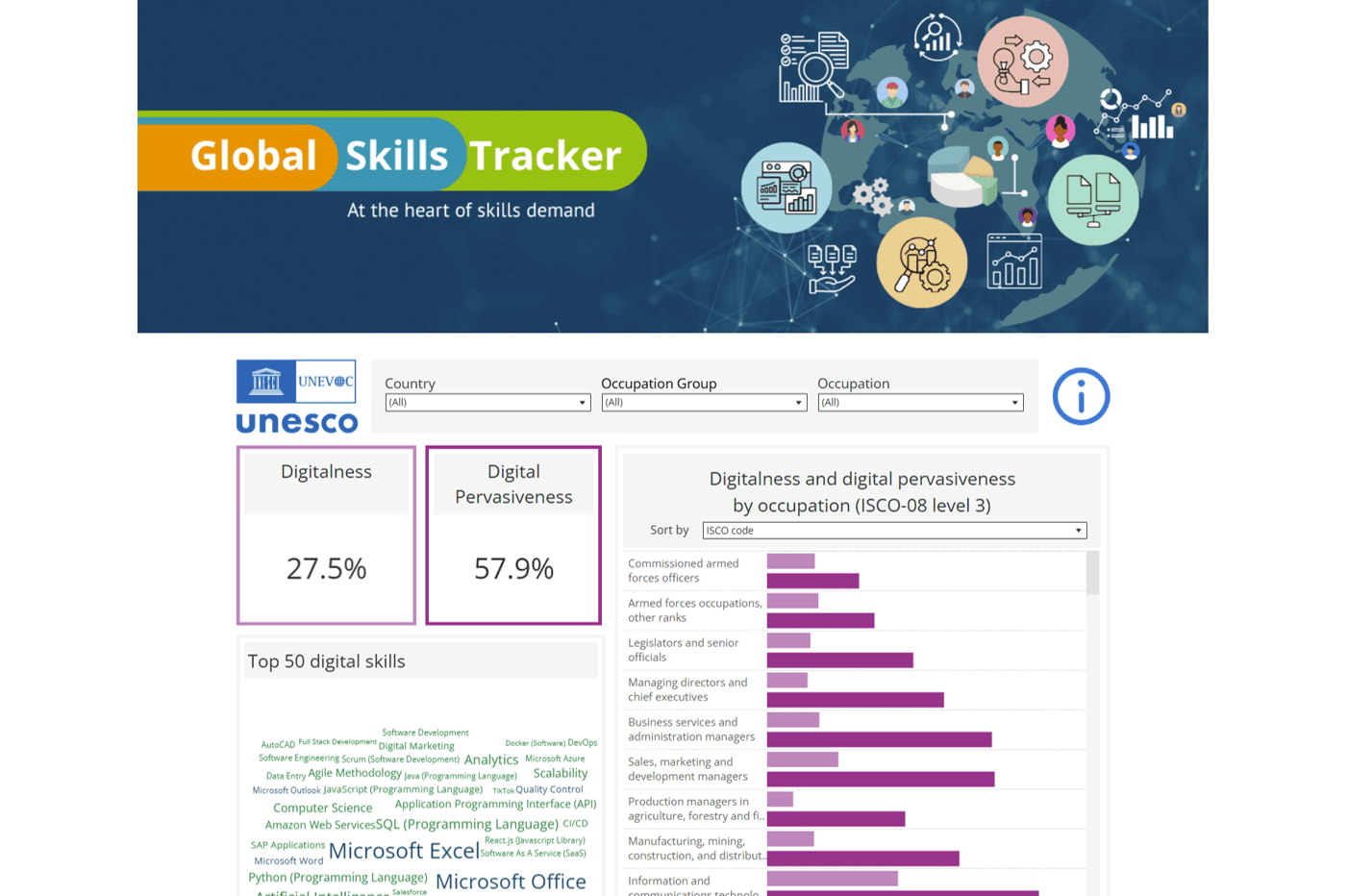
To tackle this challenge, UNESCO partnered with Lightcast to develop the Global Skills Tracker – an intuitive online platform featuring 21 interactive dashboards analysing skills across countries, industries, and occupations. By integrating traditional labor market data with real-time insights from global Online Job Adverts (OJAs), it provides a dynamic and comprehensive view of evolving skills demand.
Designed to give countries a diagnostic tool, the platform maps what employers are actually demanding by sector, occupation and skill type, against what the education system is producing. This enables policymakers and those shaping education systems to see exactly where the misalignment is, shifting TVET planning from supply-driven assumptions to demand-driven insights.
"The Global Skills Tracker is not just a map of today’s labor market; it's a call to action. With better data and sharper insights, governments, businesses, trainers, and young people can make smarter decisions and move closer to a world where everyone has the skills to thrive in the economy of the future."

How Lightcast job postings and taxonomies power the Global Skills Tracker by mapping global skills demand across countries and industries.

The heart of the Global Skills Tracker is a powerful data engine built by Lightcast, utilizing its unparalleled Skills Taxonomy and Job Posting Analytics. The Taxonomy provides the framework with which to identify skills and make them trackable at scale across countries, occupations, and sectors; the Job Posting Analytics enables the extraction of insights on employer demand, such as skills, location, job titles, experience requirements, and education levels. This is then mapped to global standards like ISCO (occupations), ISCED (education), and ISIC (industries), to create a consistent, comparable view of labor markets worldwide. This actionable intelligence enables users to quickly understand what employers are demanding by:
- •
Quantifying demand: Tracking job postings across occupations, sectors, and locations
- •
Monitoring skill trends: Using AI and NLP to identify and track in-demand skills over time
- •
Measuring transformation: Analysing the presence of key skill types, such as digital, green, and AI
The result is a clear, real-time, evidence-based view of the labor market – delivering insights in a fraction of the time than traditional research.
"Whether you are looking for insights on which sectors and occupations show the most hiring activity, where the most urgent skills gaps lie, how patterns differ across countries, or which skills are growing in key areas like digital, green, and AI, the Global Skills Tracker is a robust and powerful tool for decoding labor market trends."

How the Global Skills Tracker is delivering impact for policymakers, educators, employers, and jobseekers.

By creating a real-time feedback loop between labor markets and education systems, the platform is delivering impact across a wide range of stakeholders – from policymakers to jobseekers.
- •
Policymakers: Access to data-driven insights on global and regional labor market trends is enabling better alignment of TVET and tertiary education with emerging skills demand.
- •
Education providers: Visibility on in-demand technical, digital, and green skills is supporting the design of more relevant, future-focused curricula and training programs.
- •
Employers: Clearer insight into skills trends is helping to strengthen collaboration with governments and educators for building talent pipelines aligned to market needs.
- •
Researchers: A consistent, global view of skills demand is facilitating vital analysis of emerging labor market trends across countries, industries, and occupations.
- •
Jobseekers: Real-time information on roles and required skills is helping individuals make more informed career and training decisions relating to their future.
This impact directly supports UNESCO’s TVET Strategy 2022–2029 priorities which includes delivering skills for individuals, economies, and societies. By capturing real-time signals from employers and translating them into actionable insights, the Global Skills Tracker enables education systems to respond more quickly and effectively to demand signals, resulting in a more aligned ecosystem. Individuals gain relevant skills, employers access the talent they need, and societies benefit from more inclusive, sustainable, and resilient economies.
“The Global Skills Tracker is helping us build responsive education systems at the domestic level, but also regionally and internationally. Ultimately this is what drives UNESCO's work. As our Director-General puts it, "UNESCO for people". This platform not only serves policymakers, but also individuals, serve job seekers, youth, and adults as well.”
How the complementary UNESCO–Lightcast partnership is delivering a global skills solution that transforms lives.

The Global Skills Tracker is the result of a complementary partnership between two parties that each party brings something the other cannot replicate. UNESCO brings global institutional credibility, policy influence, access to governments and TVET systems, and a mandate to serve the public good. Lightcast brings the technical infrastructure, data science expertise, and the intelligence layer that makes the tracker function..
The result is a powerful example of how cutting-edge data science can be harnessed for the global public good. The collaboration demonstrates how private-sector data science capability, when oriented by a rigorous public mandate and deployed with the right institutional partner, can produce tools with genuine development impact.
"The Global Skills Tracker is a partnership endeavour. It involves collaboration between UNESCO and Lightcast, and also with the UNESCO-UNEVOC network, including governments, employment services, and industry. Together, we are achieving a wider purpose – a global common good serving all member states that is acting to leave no one behind.”