
The AI Displacement Delusion

Elena Magrini
Senior Economist and Head of Global Research, Lightcast

A few weeks ago Anthropic published new research on the impact of AI on the labor market. Its spider chart was everywhere on my LinkedIn feed (and if you work on labor market issues, chances are you saw it too).
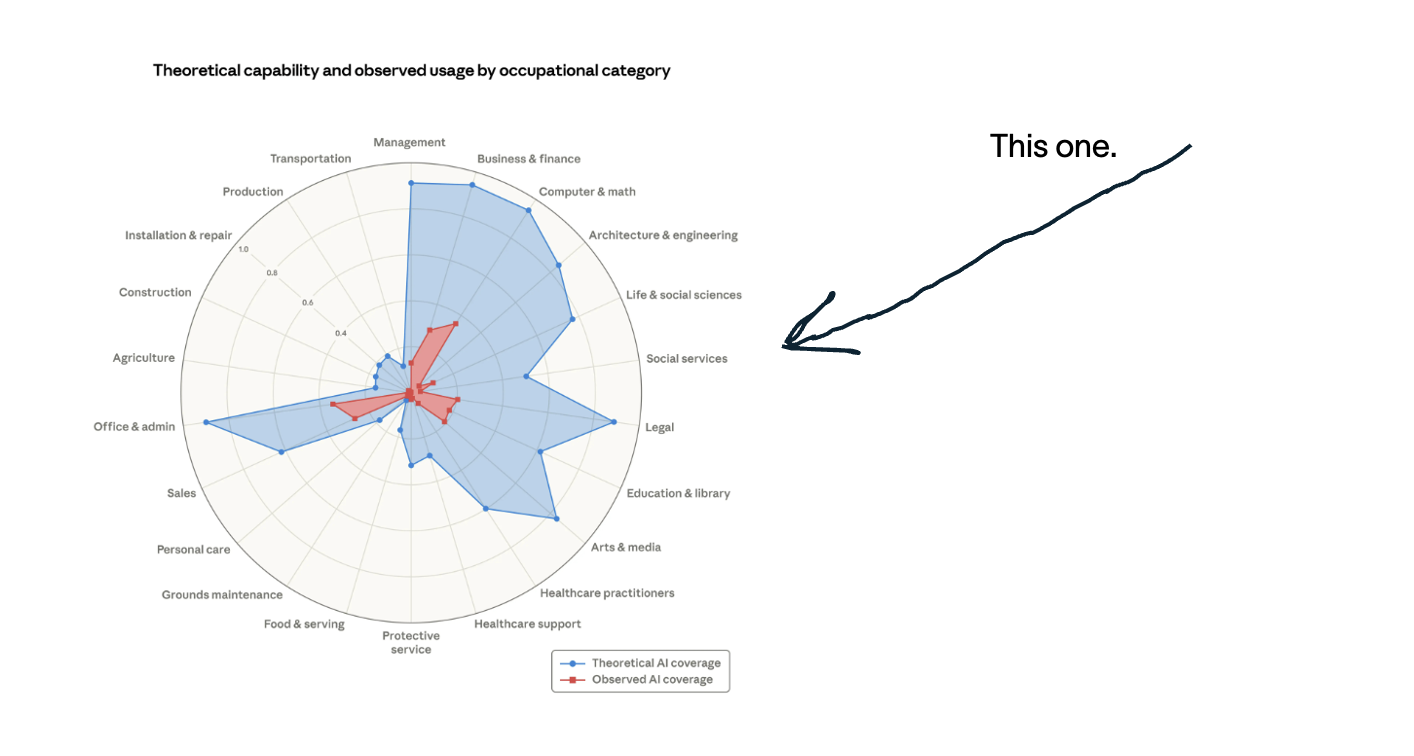
The research resonated because it tackles one of the biggest fears right now: is AI taking over jobs? It also offers insights from a uniquely interesting angle: usage data directly from one of the largest AI providers. This kind of vantage point is still rare in this debate, and it’s great to see Anthropic sharing these insights publicly.
The thing is - the conversation shouldn’t stop at the chart. If anything, work like this should push us to go deeper: not to predict which jobs will disappear, but to understand the complexity behind these changes and focus on the less glamorous work of preparing for them.
Let me explain why.
AI doesn’t decide the future of jobs - organisations do
Anthropic’s research focuses on tasks, comparing the potential for AI to perform tasks with observed usage from Claude. Grounding the analysis in real usage data is valuable and moves the discussion beyond purely theoretical estimates of automation.
But tasks are only one part of what jobs are. As Cole Napper recently pointed out, jobs are better understood as bundles of tasks, skills, and organisational choices. Looking at any one of these layers in isolation will inevitably produce only a partial picture of how work is changing.
This is why exposure does not automatically translate into displacement. As Josh Bersin noted in his commentary on the report using Lightcast labour market data, demand for software engineers remains strong despite high theoretical exposure to AI.
Let’s unpack this argument further by taking healthcare as an example. From a task perspective, many activities appear exposed to AI - summarising patient notes, analysing diagnostic images, retrieving treatment guidelines, or managing administrative documentation. But healthcare roles are built around complex bundles of skills: clinical judgement, contextual decision-making, and communication with patients, all embedded within organisational systems that determine how care is delivered.
That is why the biggest determinant of AI’s impact ultimately sits inside organisations. Technology may make certain tasks automatable, but whether that potential translates into real changes to jobs depends on strategic choices: how companies redesign roles, invest in skills, and deploy AI alongside human workers.
There’s more to the labour market than AI
A second reason the debate needs a broader lens is that AI is not the only force reshaping work right now.
In our recent research Fault Lines, we highlighted how several structural pressures are colliding in the labour market at the same time: AI, demographic changes, and geopolitics. Each of these forces influences how organisations think about talent, and their interaction matters just as much as their individual effects.
Healthcare again offers a useful example. Many advanced economies are already facing ageing populations and rising demand for care at the same time as the healthcare workforce itself is ageing. In simple terms, fewer people are entering the labour market than leaving it - precisely as demand for healthcare services increases.
In this context, the role of AI looks very different from the “robots replacing workers” narrative and could potentially help ease some of the sector pressures. AI tools that reduce administrative burden, support diagnostics, or streamline workflows may help clinicians manage growing demand rather than replace them. Yet, as we highlight in the research (see chart below), AI adoption in the healthcare sector is still too low compared to what the sector needs to address its labour shortages.

This highlights how not just organizational choices - but also external factors beyond the technology alone - drive decisions about AI adoption. Labour shortages, access to talent, regulatory environments, and organisational constraints all influence how AI is actually used in practice.
Preparation beats prediction - navigating uncertainty requires joining the dots
All of this points to a broader conclusion: the real challenge is not predicting which jobs AI will replace, but helping organisations prepare for how work is evolving.
Predictions about job loss tend to focus on a single lens - tasks, exposure, or technological capability - but labor markets are complex systems, and no single dataset can capture the full picture.
As we frequently highlight, preparation requires connecting multiple sources of insight. Usage data from AI systems provides one signal. Labor market data, such as job postings, skills demand, and occupational trends, offers another. Internal workforce data inside organisations provides yet another layer.
This is where a skills-based perspective becomes particularly powerful. Last summer, in our research Beyond the Buzz, we showed how analysing the skills within jobs can reveal which capabilities are being disrupted by AI and which remain uniquely human. Instead of asking whether a job will disappear, this approach asks a more useful question: which skills within that job are changing, and what does that mean for workers and organisations? We then go a step further, building a Skill Disruption Matrix to help organisations practically start painting a picture of what’s needed today to build for tomorrow (here below you see an example for HR).

Understanding these shifts requires looking across tasks, skills, occupations, and labor market trends together - and connecting those external signals with the decisions organisations are making internally about how work gets done.
Preparing for AI, in other words, is less about predicting a single future and more about building the data infrastructure and analytical capability needed to navigate uncertainty. That means moving beyond headlines about job loss and focusing on the harder - and ultimately more valuable - work of understanding how jobs are evolving and how organisations can adapt.
Recent Posts

The Lightcast Skills Taxonomy

Stop Predicting the Future. Start Preparing for It.
